Welcome to Maths For Fun – where mathematical curiosity meets pure enjoyment for learners of all ages! Founded by a team of lifelong maths enthusiasts, we believe that numbers aren’t just for tests – they’re for exploration, discovery, and delight. Whether you’re eight or eighty, a beginner or a seasoned problem solver, you’ll find a growing collection of logic based games and puzzles that cover every corner of mathematics.
Welcome to Maths For Fun – where mathematical curiosity meets pure enjoyment for learners of all ages! Founded by a team of lifelong maths enthusiasts, we believe that numbers aren’t just for tests – they’re for exploration, discovery, and delight. Whether you’re eight or eighty, a beginner or a seasoned problem solver, you’ll find a growing collection of logic based games and puzzles that cover every corner of mathematics.
Unveiling the Spiral: The Fibonacci Sequence in Flower Petals and Pine Cones
In the realm of nature, Fibonacci patterns in nature manifest themselves beautifully, particularly through flower petals and pine cones. These mathematical sequences highlight how plants optimise their growth and reproduction.
In the realm of nature, Fibonacci patterns in nature manifest themselves beautifully, particularly through flower petals and pine cones. These mathematical sequences highlight how plants optimise their growth and reproduction. Understanding phyllotaxis and spiral geometry provides insight into this incredible phenomenon. The golden angle plays a crucial role in botany, influencing the arrangement of seeds in a sunflower and the intricate scales of a pine cone. As we explore these sequences, we uncover the seamless connection between mathematics and the natural world. From vibrant flowers to resilient conifers, the Fibonacci sequence guides the formation of these wonders, illustrating how nature adheres to mathematical principles for performance and beauty. Join us as we unveil the spiral and delve deeper into the significance of these patterns in our environment.
2) The mystery deepens: why Fibonacci patterns in nature keep turning up (setup → conflict → resolution)
Walk through any garden and the pattern quietly repeats. Petals often cluster in fives, eights, or thirteens. Pine cones reveal spirals that match the same counts.
This is where the mystery deepens, because it happens without a designer. Plants do not “know” maths, yet their structures echo it. The recurrence makes Fibonacci patterns in nature feel almost uncanny.
The conflict lies between beauty and biology. If these numbers were mere coincidence, they should appear randomly. Instead, they show up in unrelated species across climates and continents.
One tempting explanation is that plants simply copy what worked before. Yet evolution does not aim for neat sequences. It favours forms that survive, even if they look messy.
The resolution begins at the growing tip, where new buds compete for space. Each new element must fit among older ones without blocking light. The best placement spreads them evenly around the stem.
That spacing often settles near the golden angle, about 137.5 degrees. This angle reduces overlap as the plant expands. It also creates interlocking spirals that count Fibonacci numbers.
Over time, the visible spirals are a by-product of efficient packing. Seeds, scales, and petals arrange to maximise exposure and minimise wasted gaps. What looks like a secret code is a practical solution.
So the mystery does not vanish, but it becomes grounded. Fibonacci patterns keep turning up because plants face the same constraints. Where growth meets geometry, the spiral naturally emerges.
3) From rabbit maths to plant form: a quick, research-focused primer on the Fibonacci sequence
The Fibonacci sequence begins as 0, 1, 1, 2, 3, 5, 8, and onward. Each term equals the sum of the previous two. It first appeared in Western maths through Fibonacci’s rabbit problem in 1202.
In research, the real interest is not rabbits at all. It is how ratios of consecutive terms approach the golden ratio, about 1.618. This limiting ratio links directly to efficient packing and stable growth.
In plants, new leaves or florets emerge from a growing tip. If each new unit forms at roughly the golden angle, overlaps reduce. That angle is about 137.5 degrees, derived from the golden ratio.
This process is called phyllotaxis in botany and modelling. It can be tested by counting spirals on cones or flower heads. Many specimens show adjacent spiral counts that are Fibonacci numbers.
Biologists often stress that Fibonacci counts are an outcome of growth rules, not a target. When spacing is near the golden angle, Fibonacci patterns in nature become a likely by-product.
However, the pattern is not universal or perfect. Spiral counts can vary with species, genetics, and growing conditions. Some plants show Lucas numbers or other near-Fibonacci sequences.
For a quick, research-focused view, treat Fibonacci as a descriptive tool. It summarises how simple rules can yield common spiral forms. It also helps compare real specimens with idealised growth models.
4) Petals as data points: what flower-petal counts really show (and what they don’t)
Flower petals are often presented as easy proof of Fibonacci patterns in nature. Count petals on lilies or buttercups, and you may see 3, 5, or 8. These tallies make petals feel like tidy, visible data points.
Yet petal counts are not a universal rule, and the “right” number is not guaranteed. Many species vary between individuals, seasons, and habitats. Even a single plant may produce flowers with different counts.
A key issue is that people tend to sample familiar garden flowers. That creates a quiet bias towards species that already match the story. If you broaden the sample, the pattern becomes less neat.
Developmental biology also complicates the count. Petals can fuse, split, or become hard to distinguish from sepals. What looks like one petal might be several parts combined.
Some flowers do not have petals at all, but petal-like structures. In daisies, for instance, the “flower” is a whole head. The ray florets and disc florets follow different developmental rules.
If you want evidence, treat petal counts like real data. Look for large surveys, not memorable examples. The Royal Botanic Gardens, Kew provides botanical information useful for checking structures and terminology: https://powo.science.kew.org/
The most reliable Fibonacci signals often appear in spirals, not petals. Seed heads, cones, and leaf arrangements can show clearer phyllotaxis patterns. Petals still matter, but they are a starting clue, not a conclusion.
5) Pine cones under the lens: opposing spirals, scale counts and reproducible observations
Flower-petal counts are often presented as tidy proof of Fibonacci patterns in nature, but the reality is both more interesting and more nuanced. Petals can be treated as data points because they’re easy to see, quick to record, and surprisingly consistent within certain plant groups. Many species do cluster around familiar numbers such as 3, 5, 8, 13, or 21, which can make a garden look like a living maths textbook. Yet that apparent neatness can be an artefact of what we choose to count and how we choose to sample.
A key limitation is that “petals” are not always comparable across flowers. In some blooms, what looks like a petal is actually a sepal, a bract, or a fused structure, and different guides disagree on where one unit ends and another begins. Petal numbers can also shift with cultivation, hybridisation, or environmental stress, and “double” varieties in particular multiply petal-like parts in ways that obscure the original pattern. Even within a single species, you may find occasional deviations that are biologically normal rather than errors in observation.
It’s also worth remembering that Fibonacci-linked spirals arise most robustly in the arrangement of repeated organs around a stem or centre, not merely in the final number you can tally at a glance. Counting petals alone tells you little about the underlying growth rule, because the same count can be produced by different developmental pathways. Used carefully, petal counts are a good starting dataset; used uncritically, they can turn a subtle story of plant development into a simplistic scoreboard of “Fibonacci or not”.
6) The hidden rule of packing: phyllotaxis, the golden angle in botany and spiral geometry
Phyllotaxis is the study of how plants place leaves, petals, and seeds on a stem. It reveals a hidden packing rule that balances growth, light, and space.
Many species follow the golden angle, about 137.5 degrees between new growth points. This offset avoids overlap and keeps each new element well spaced.
Over time, this steady rotation creates spirals that you can count. The spirals often match neighbouring Fibonacci numbers, such as 34 and 55. That is why Fibonacci patterns in nature appear so often in cones and flower heads.
Pine cones show this clearly because their scales lock into a stable grid. You can trace one spiral clockwise and another anticlockwise. Each direction tends to give a Fibonacci count.
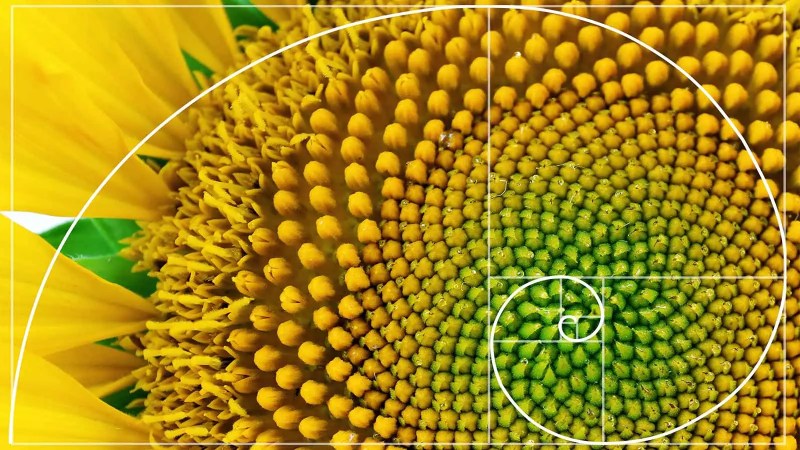
Sunflowers use the same packing principle for seeds. New seeds form near the centre and push older ones outward. The golden angle minimises gaps as the head expands.
This geometry is not a mystical design, but a practical solution. Plants grow by adding one unit at a time. A near-irrational angle spreads additions evenly around the stem.
Spiral geometry also explains why the pattern stays consistent under changing size. As the plant enlarges, the same angle keeps points distributed. The result is an efficient, repeatable blueprint for natural packing.
When you spot these spirals, you are seeing growth recorded in structure. Phyllotaxis links botany to mathematics in a visible way. It turns everyday petals and cones into living diagrams of optimal arrangement.
7) Practical examples: counting spirals in sunflowers, daisies and other composite flowers
In composite flowers, the Fibonacci sequence becomes wonderfully tangible because you can often verify it with your own eyes. Sunflowers are the classic example: what look like simple seeds are actually tiny florets packed into a disc, arranged to fill space efficiently as the head grows. If you trace the spirals that curve outwards in one direction and then count the spirals curving the other way, you’ll frequently find two neighbouring Fibonacci numbers, such as 34 and 55, or 55 and 89. These paired counts reflect the way new florets are added at a consistent angle, producing interlocking spiral families that minimise gaps and keep the pattern stable as the flower expands.
Daisies and similar composite flowers in the Asteraceae family offer a smaller, more approachable canvas for the same idea. In many varieties, the central disc shows subtle spiral arcs that become clearer if you look closely or take a photograph and trace the curves with your finger. Because the heads are smaller and can be affected by variety, growth conditions, and developmental quirks, the counts aren’t always as dramatic as in sunflowers, but it’s common to see spiral totals that still fall near Fibonacci values. This is one reason Fibonacci patterns in nature are best treated as a recurring tendency rather than a rigid rule.
Pine cones provide a satisfying comparison because their scales form visible diagonal rows. Here again, you can count the spirals in opposite directions and often arrive at neighbouring Fibonacci numbers, frequently 8 and 13, or 13 and 21. The appeal of these practical examples lies in how they connect a familiar walk in the garden or woodland with a deeper story about growth, packing, and the mathematics that so often underpins natural form.
8) Methods researchers can trust: sampling, imaging, statistics and avoiding confirmation bias
Reliable work on Fibonacci patterns in nature starts with clear sampling rules. Researchers should predefine species, sites, and seasons. Random or stratified sampling helps avoid only choosing “perfect” specimens.
Sample sizes need justification, not guesswork. Power calculations can estimate the numbers required for meaningful comparisons. Recording failures matters too, including damaged cones and irregular blooms.
Imaging should be repeatable and well documented. Use consistent lighting, scale bars, and fixed camera angles. For dense spirals, micro-CT or calibrated macro photography improves counting accuracy.
Measurement protocols must be explicit. Define what counts as a petal, floret, or spiral. Train multiple raters and check inter-rater reliability.
Statistics should test alternatives, not just confirm expectations. Compare observed spiral counts against null models and known developmental constraints. Use confidence intervals, and report uncertainty, not just averages.
Pre-registration reduces confirmation bias and selective reporting. Commit to hypotheses, methods, and exclusions before seeing results. Share data and code so others can replicate analyses.
Peer checking also helps prevent pattern hunting. Blind counting, where possible, limits expectation effects. Automated spiral detection can be audited against manual counts.
As the Royal Society notes, “[pre-registration] helps to prevent publication bias and ‘p-hacking’” (https://royalsociety.org/blog/2017/06/preregistration/). That principle applies strongly when counting spirals. It encourages reporting messy realities, not only neat Fibonacci hits.
Finally, interpret results cautiously and biologically. Fibonacci-like counts can emerge from growth rules, not “magic numbers”. Trustworthy methods separate genuine structure from our desire to see order.
Conclusion
The Fibonacci sequence reveals a fascinating aspect of the natural world, evident in flower petals and pine cones. By exploring phyllotaxis and spiral geometry, we understand how the golden angle influences plant structures. The growth patterns seen in sunflower seeds and the numerical precision of pine cone scales reflect nature’s adherence to mathematical principles. These Fibonacci patterns in nature not only signify efficiency but also enhance the aesthetic appeal of various species. Appreciating these spirals provides us with a greater understanding of the interconnectedness of life and mathematics. Stay tuned for more insights into the wonders of nature and the intricate patterns that define it. Subscribe to our newsletter for the latest updates!
Ready to make maths more enjoyable, accessible, and fun? Join a friendly community where you can explore puzzles, ask questions, track your progress, and learn at your own pace.
Your personal dashboard with points & achievements
A supportive space built for every level of learner
New features and updates as the Hub grows
Manage Consent
To provide the best experiences, we use technologies like cookies to store and/or access device information. Consenting to these technologies will allow us to process data such as browsing behavior or unique IDs on this site. Not consenting or withdrawing consent, may adversely affect certain features and functions.
Functional
Always active
The technical storage or access is strictly necessary for the legitimate purpose of enabling the use of a specific service explicitly requested by the subscriber or user, or for the sole purpose of carrying out the transmission of a communication over an electronic communications network.
Preferences
The technical storage or access is necessary for the legitimate purpose of storing preferences that are not requested by the subscriber or user.
Statistics
The technical storage or access that is used exclusively for statistical purposes.The technical storage or access that is used exclusively for anonymous statistical purposes. Without a subpoena, voluntary compliance on the part of your Internet Service Provider, or additional records from a third party, information stored or retrieved for this purpose alone cannot usually be used to identify you.
Marketing
The technical storage or access is required to create user profiles to send advertising, or to track the user on a website or across several websites for similar marketing purposes.