Welcome to Maths For Fun – where mathematical curiosity meets pure enjoyment for learners of all ages! Founded by a team of lifelong maths enthusiasts, we believe that numbers aren’t just for tests – they’re for exploration, discovery, and delight. Whether you’re eight or eighty, a beginner or a seasoned problem solver, you’ll find a growing collection of logic based games and puzzles that cover every corner of mathematics.
Welcome to Maths For Fun – where mathematical curiosity meets pure enjoyment for learners of all ages! Founded by a team of lifelong maths enthusiasts, we believe that numbers aren’t just for tests – they’re for exploration, discovery, and delight. Whether you’re eight or eighty, a beginner or a seasoned problem solver, you’ll find a growing collection of logic based games and puzzles that cover every corner of mathematics.
From the Fibonacci Sequence to Musical Chords: Discovering Patterns in Sound
From the Fibonacci Sequence to musical chords, the exploration of patterns in sound reveals a fascinating connection between mathematics and music. Fibonacci patterns in music illustrate how natural number sequences can influence melody, harmony, and rhythm.
From the Fibonacci Sequence to musical chords, the exploration of patterns in sound reveals a fascinating connection between mathematics and music. Fibonacci patterns in music illustrate how natural number sequences can influence melody, harmony, and rhythm. The golden ratio in music enhances aesthetic appeal and emotional resonance, making it a vital concept in music theory for beginners. Understanding how the harmonic series operates is essential for grasping chord progressions and maths in music composition. This article delves into these captivating ideas, showcasing how numbers, patterns, and music intertwine to create beautiful soundscapes that touch our hearts and souls.
2) The day Fibonacci patterns in music turned up in a melody (setup → conflict → resolution)
It began as a casual listening session, the sort that fades into background noise. Then a simple melody caught my ear, repeating with unusual poise. It felt balanced, yet never predictable, like it knew where to go next.
I tried to hum it back and noticed the phrases were not equal lengths. One idea lasted two beats, the next three, then five. The pattern kept returning, but it disguised itself with small variations. That was the moment curiosity turned into suspicion.
The conflict arrived when analysis refused to confirm what I thought I heard. The bar lines suggested regularity, yet the musical sentences leaned elsewhere. When I mapped the accents, the expected symmetry failed. It was frustrating, because the melody still sounded naturally “right”.
So I shifted focus from bars to breaths, treating the tune like a spoken line. Counting note groups instead of measures, the relationships became clearer. Short motifs led into longer ones, growing by familiar steps. Suddenly, Fibonacci patterns in music stopped sounding like a clever theory.
The resolution was not a perfect mathematical proof, but a convincing musical one. The composer had shaped tension and release using proportional growth. It explained why the tune felt organic, even when it avoided neat repetition. In that small melody, numbers were not rules, but a quiet guide.
Discover our terms and conditions for a safe and enjoyable experience by visiting our Terms of Use page, and don’t forget to check out our Cart for exciting educational math resources!
3) A quick-and-friendly primer: Fibonacci, the golden ratio in music, and why our brains love patterns
Fibonacci is a number sequence where each term adds the two before it.
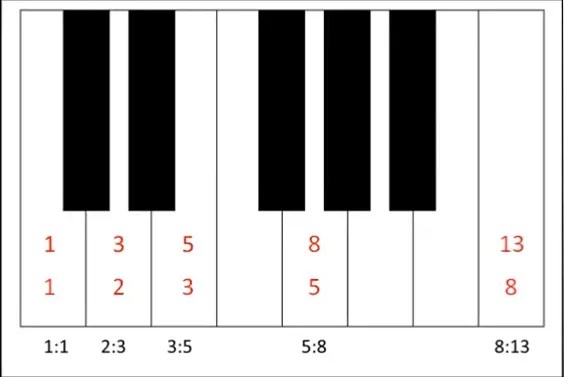
You’ll see 1, 1, 2, 3, 5, 8, 13, and so on.
It turns up in nature, design, and surprisingly often in sound.
A close cousin is the golden ratio, about 1.618.
In music, it can guide where a climax lands in a phrase.
It can also shape bar lengths, sections, and repeating motifs.
You don’t need maths to enjoy it.
Many composers and producers use these proportions by instinct.
Later, analysts spot Fibonacci patterns in music and label the effect.
Our brains love patterns because they help prediction.
Prediction makes listening feel safe, yet still interesting.
Music balances expectation and surprise across rhythm, melody, and harmony.
A Fibonacci-style build can feel “right” without feeling obvious.
A section might grow 8 bars, then 13 bars, then resolve.
A riff may repeat in 3, 5, and 8-beat groupings.
When musical structure mirrors natural growth patterns, listeners often report a sense of coherence and flow.
Still, it’s not a magic formula.
Great songs break rules as often as they follow them.
Use Fibonacci as a creative prompt, not a strict blueprint.
4) Where Fibonacci patterns in music might hide in songs: structure, climaxes, and phrasing
Fibonacci patterns in music may be easiest to spot in how songs are arranged over time. Many writers favour balanced forms that feel natural and inevitable. Those instincts can echo Fibonacci-like proportions without any deliberate maths.
Listen for where verses, choruses, and bridges seem to “snap” into place. A shift might arrive after 13 or 21 bars, or around those counts in beats. Even when counts vary, the sensation of proportion can remain.
Climaxes are another likely hiding place, especially in long builds. In some tracks, the emotional peak lands near the golden ratio of total duration. That moment often feels earned, not rushed.
Phrasing can show similar tendencies at smaller scales. Vocal lines often breathe in lengths that resemble 5, 8, or 13 beats. Instrumental motifs may expand by adding notes in those familiar steps.
Editing choices can reinforce these shapes during production. A repeated hook might return after a slightly longer gap each time. That subtle stretching can mimic Fibonacci growth in perceived momentum.
This does not mean every song secretly follows a strict sequence. Popular music is full of exceptions, and feel often beats counting. Still, Fibonacci patterns in music offer a useful lens for close listening.
If you want background data on the sequence itself, start with the Fibonacci number reference at https://oeis.org/A000045. Pair that with a waveform timeline, and you can test where peaks occur. Over time, you may notice patterns that match how your ears already work.
5) The physics bit (without the headache): the harmonic series explained and why chords feel ‘right’
Songwriters rarely sit with a calculator, yet Fibonacci patterns in music can still appear because our sense of tension and release often prefers proportions that feel “just right”. One place they can hide is in overall form: a verse–chorus song may place its most emotionally charged moment not dead-centre, but a little later, so the track feels like it’s continually gathering momentum. If a climax arrives around the 60%–65% mark, listeners often experience it as earned rather than rushed, even if the artist never intended a mathematical nod.
A second hiding place is phrasing. Melodic lines frequently balance repetition with a slight extension: a motif might return, then stretch by a bar or two, creating a subtle asymmetry that keeps attention without sounding irregular. In vocal writing, this can show up as an extra syllable, a held note, or a delayed resolution that makes the next chord change feel more satisfying.
Finally, arrangements and production can reinforce these proportions. A track may “bloom” by adding layers in stages, then thinning out just before the high point, mirroring natural growth patterns. Listen for how many measures it takes to build from the first full drum entrance to the biggest chorus, or how long a breakdown lasts before the final lift. Even when approximate, these relationships can make a song feel coherent: the structure seems to breathe, climaxes land with impact, and phrasing feels both familiar and alive.
6) Hands-on experiment: build a chord progression and map Fibonacci numbers onto rhythm and phrase length
Try this quick exercise to hear Fibonacci patterns in music. You will build a chord loop, then shape rhythm and phrasing. Keep a notebook nearby to track choices.
Start with a simple key, such as C major or A minor. Choose four chords you already know, and play them evenly. For example: Am–F–C–G works well on guitar or piano.
Now map Fibonacci numbers onto bar lengths for each chord. Use 1, 1, 2, 3, 5, 8 as your building blocks. Assign each chord a duration of 1, 2, 3, or 5 bars. Loop it until the full cycle feels natural.
Next, apply Fibonacci counts to your rhythm. Pick one chord and strum or play 3 hits per bar. On the next chord, play 5 hits per bar using even quavers. On the third chord, try 8 hits per bar with light accents.
Create phrases using Fibonacci bar totals. Write a short section lasting 8 bars. Follow it with a contrasting section of 13 bars. If 13 feels long, split it into 5 + 8 bars.
Record a rough take on your phone and listen back. Notice how the uneven lengths create forward motion. Adjust only one element at a time, keeping the Fibonacci scaffold in place.
7) A listening tour: famous examples (and near-misses) of maths-inspired composition
For a quick listening tour, it helps to start with composers who wore their fascination with numbers on their sleeve. Béla Bartók is often cited for weaving proportions associated with the golden ratio into the pacing of movements, shaping climaxes so they feel uncannily “right” even when the listener can’t explain why. Claude Debussy’s music, too, is frequently discussed in terms of proportion and symmetry, not because it sounds mathematical, but because its balance of repetition and variation can mirror the kind of growth patterns we recognise from nature.
In the twentieth century, the link between arithmetic and sound becomes more explicit. Iannis Xenakis, trained as an engineer and architect, used probabilistic models and geometric thinking to generate dense, shifting textures that feel like organised turbulence. Steve Reich and Philip Glass explored process: short motifs repeat, phase, and gradually evolve, making the underlying structure audible as it unfolds. This is where many people first go hunting for Fibonacci patterns in music, listening for phrases that lengthen in a familiar sequence or for sections that arrive at moments of striking proportionality.
Yet it’s worth enjoying the near-misses as much as the “proofs”. Analysts sometimes retrofit Fibonacci claims onto pieces where the evidence is selective, or where editorial decisions and performance timings blur any neat numerical target. Even so, these readings can still be valuable: they train the ear to notice pacing, recurrence, and expectation. Whether the maths was intended, approximate, or accidental, the result can be the same—music that feels patterned, coherent, and satisfyingly alive.
8) When patterns become a trap: how to stay musical, not mechanical
Patterns can sharpen your writing and make choices feel clear. Yet, once rules take over, music can lose its human pulse. Use patterns as guides, not as a cage.
It is easy to force structure onto every bar and phrase. Fibonacci patterns in music can become a checklist, not a spark. If your ear disagrees, trust the ear.
A helpful reminder comes from Debussy: “There is no theory. You have only to listen.” The quote is widely cited and appears on Goodreads. It frames theory as a tool, not a master.
To stay musical, begin with intention rather than arithmetic. Ask what emotion the section must carry. Then let any sequence serve that feeling.
Build in “imperfections” on purpose to keep things alive. Shift an accent, stretch a phrase, or swap a chord colour. Keep the pattern in the background, like a skeleton.
Finally, test your pattern choices in context, not in isolation. Record a quick sketch and listen back the next day. If it sounds clever but cold, simplify and sing it through.
Conclusion
In conclusion, the journey through Fibonacci patterns in music and the golden ratio in music enriches our understanding of musical structure. By grasping the basic principles of music theory for beginners, anyone can explore how the harmonic series affects chord progressions and maths in music. These patterns not only aid in composition but also heighten our appreciation of the emotional power of sound. Discovering these connections can transform how we experience music. Share this enlightening exploration with fellow music enthusiasts and spark a conversation about the beautiful intersection of maths and sound!
Ready to make maths more enjoyable, accessible, and fun? Join a friendly community where you can explore puzzles, ask questions, track your progress, and learn at your own pace.
Your personal dashboard with points & achievements
A supportive space built for every level of learner
New features and updates as the Hub grows
Manage Consent
To provide the best experiences, we use technologies like cookies to store and/or access device information. Consenting to these technologies will allow us to process data such as browsing behavior or unique IDs on this site. Not consenting or withdrawing consent, may adversely affect certain features and functions.
Functional
Always active
The technical storage or access is strictly necessary for the legitimate purpose of enabling the use of a specific service explicitly requested by the subscriber or user, or for the sole purpose of carrying out the transmission of a communication over an electronic communications network.
Preferences
The technical storage or access is necessary for the legitimate purpose of storing preferences that are not requested by the subscriber or user.
Statistics
The technical storage or access that is used exclusively for statistical purposes.The technical storage or access that is used exclusively for anonymous statistical purposes. Without a subpoena, voluntary compliance on the part of your Internet Service Provider, or additional records from a third party, information stored or retrieved for this purpose alone cannot usually be used to identify you.
Marketing
The technical storage or access is required to create user profiles to send advertising, or to track the user on a website or across several websites for similar marketing purposes.