Welcome to Maths For Fun – where mathematical curiosity meets pure enjoyment for learners of all ages! Founded by a team of lifelong maths enthusiasts, we believe that numbers aren’t just for tests – they’re for exploration, discovery, and delight. Whether you’re eight or eighty, a beginner or a seasoned problem solver, you’ll find a growing collection of logic based games and puzzles that cover every corner of mathematics.
Welcome to Maths For Fun – where mathematical curiosity meets pure enjoyment for learners of all ages! Founded by a team of lifelong maths enthusiasts, we believe that numbers aren’t just for tests – they’re for exploration, discovery, and delight. Whether you’re eight or eighty, a beginner or a seasoned problem solver, you’ll find a growing collection of logic based games and puzzles that cover every corner of mathematics.
Unlocking the Power of Mental Math: Techniques to Inspire Learners
Unlocking the power of mental math can transform the way students engage with numbers. By employing powerful mental maths techniques, educators can cultivate strong number sense in the classroom.
Unlocking the power of mental math can transform the way students engage with numbers. By employing powerful mental maths techniques, educators can cultivate strong number sense in the classroom. These strategies not only enhance maths fluency but also promote mental calculation shortcuts. When students gain confidence in maths, they approach problem-solving with a greater sense of ease and enthusiasm. This article delves into effective methods that inspire learners to master mental maths, offering practical tips that teachers can implement immediately. These techniques will support students in developing essential skills that are vital for their academic success and everyday life. Join us as we explore the impact of mental maths on learning and discover how to create a vibrant maths classroom where every student can thrive.
Getting Started with Powerful Mental Maths Techniques (Without Overwhelming Learners)
Getting started with mental maths should feel inviting, not intimidating. Learners build confidence faster when early wins come quickly and clearly.
Begin by reinforcing number sense rather than rushing into speed. Simple estimates, friendly numbers, and rounding create a calm foundation for accuracy.
Introduce one idea at a time and let it settle through repetition. When learners practise a single method, the brain stops scrambling.
Powerful mental maths techniques work best when linked to everyday tasks. Shopping totals, time calculations, and quick comparisons make practice feel useful.
Encourage learners to speak their thinking aloud in short phrases. This makes patterns visible and reduces hidden mistakes.
It also helps to normalise pauses and checking. Mental maths is about control, not constant rapid answers.
Keep practice sessions brief and consistent, so effort stays manageable. A few focused minutes often beats a long, tiring drill.
Finally, celebrate progress in strategies, not just correct results. When learners notice improved methods, motivation stays strong and steady.
Discover exciting features and connect with others at our community hub by clicking here!
What’s Really Going On in Learners’ Heads? Building Number Sense and Flexible Thinking
In a learner’s mind, mental maths is less about speed. It is more about patterns, meaning, and choice. When learners build number sense, they stop clinging to a single method.
They begin to see numbers as flexible objects. For example, 47 can become 50 minus 3. This shift reduces strain on working memory.
Strong mental calculation often reflects strong number relationships, not “quick thinking”. Teach links between numbers, and fluency follows.
Number sense grows through repeated, varied experiences. Learners compare quantities, estimate, and spot structure. They also learn that mistakes can reveal useful patterns.
Flexible thinking develops when learners can switch strategies. They might bridge through ten, partition, or compensate. Choosing a method becomes part of the task.
Powerful mental maths techniques rely on this inner toolkit. Learners rehearse facts, yet they also reframe problems. That is how they move from recall to reasoning.
Encourage them to explain choices out loud. Ask, “Why did that feel easier?” Then invite a second method to confirm the result.
Over time, learners develop efficient habits. They anticipate number bonds and common multiples. They also gain confidence with unfamiliar calculations.
Keep tasks low in writing, but rich in thinking. Use short problems with multiple routes. That is where number sense becomes visible.
Classroom-Ready Routines: Quick Wins for Daily Maths Fluency
Daily routines can transform mental maths from a one-off activity into a lasting habit. When pupils practise little and often, confidence rises and anxiety falls.
Start each lesson with a brisk, low-stakes warm-up that feels familiar. Quick recall of number bonds, doubles, and times tables builds automaticity over time.
Choral response can sharpen focus and reduce hesitation in mixed-attainment groups. Short, spoken calculations also encourage clear mathematical language and attentive listening.
Build in “talk the strategy” moments, where pupils explain how they reached an answer. Hearing different approaches normalises flexible thinking and strengthens reasoning.
Use mini whiteboards for fast checking without slowing the pace of teaching. Immediate feedback helps you spot misconceptions before they become fixed.
Vary the routine by shifting the representation, not the difficulty. Ask pupils to see the same calculation as a bar model or number line.
Link practice to meaningful contexts, such as money, measures, or time. This helps pupils transfer powerful mental maths techniques beyond the classroom.
Keep progress visible with simple class goals and personal bests. A clear sense of improvement motivates pupils to sustain effort.
Evidence supports frequent retrieval and practice to strengthen long-term learning. The Education Endowment Foundation summarises relevant findings here: https://educationendowmentfoundation.org.uk/education-evidence/guidance-reports/maths-ks-2-3.
Technique Spotlight: Partitioning and Recombining to Make Hard Sums Feel Easy
Daily routines are where powerful mental maths techniques become habits rather than one-off tricks. A short, predictable fluency slot at the start of each lesson helps learners settle quickly, practise retrieval, and build confidence with number relationships. Keep the pace brisk and the language consistent, so pupils can focus on thinking rather than deciphering instructions, and vary the numbers to provide challenge without changing the structure.
A simple way to embed these routines is to rotate a small set of classroom-ready tasks. The aim is not to race for the “right” answer, but to normalise explaining strategies out loud, comparing methods, and spotting efficient shortcuts. Over time, learners begin to anticipate useful moves such as compensating, partitioning, and using known facts, which supports both arithmetic accuracy and reasoning across the curriculum.
Here are quick, repeatable routines you can use to build daily maths fluency with minimal preparation.
Routine
What pupils do
Teacher prompt
Number of the Day
Represent one number in multiple ways (equations, place value, factors).
“Show me three different ways to make 48.”
Beat the Calculator
Pupils solve a calculation mentally, then justify why their method is efficient. This builds confidence and reduces reliance on written methods for manageable numbers.
“How can you do 199 + 36 without column addition?”
Flash & Explain
See a brief calculation, then explain the mental strategy used.
“What did you change, and why?”
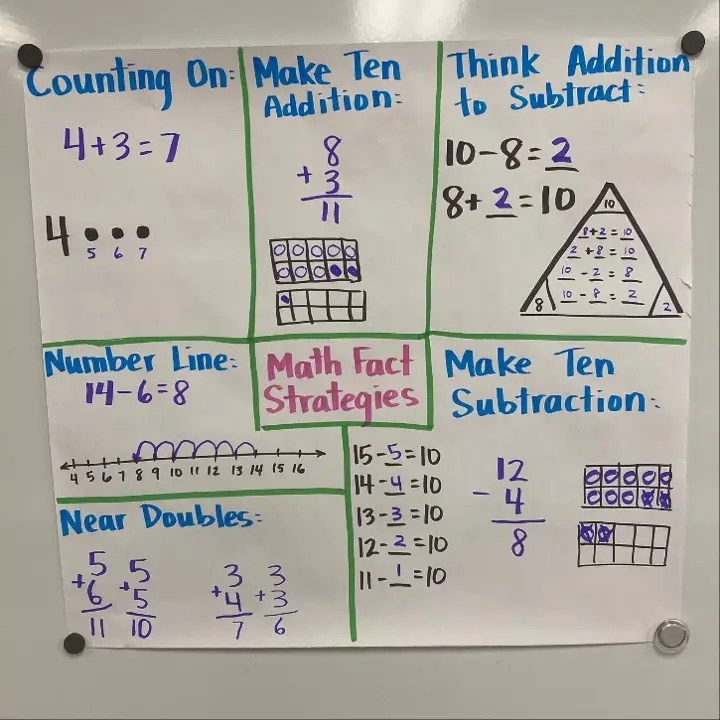
Near Doubles
Use doubles facts to solve adjacent facts quickly.
“If 7 + 7 is 14, what is 7 + 8?”
Make Ten/Make One
Rearrange addends to bridge to a friendly number.
“Which part can you move to make 10 or 100?”
Estimate then Calculate
Give a sensible estimate first, then refine to the exact answer.
“What’s a quick estimate for 58 × 6?”
Used consistently, these routines create a shared culture of strategy and explanation, helping every learner develop faster recall, stronger number sense, and more flexible thinking.
Technique Spotlight: Compensation Strategies for Fast, Accurate Adjustments
Compensation is a smart way to adjust numbers for easier calculations. You change a value to a friendly number, then correct the difference.
For addition, round one number up to a tidy ten or hundred. Add quickly, then subtract the extra you added. For example, 398 + 27 becomes 400 + 27 = 427, then minus 2.
You can also round down when it suits the numbers. Try 512 + 89 as 512 + 90 = 602, then minus 1. Learners enjoy seeing that accuracy stays intact.
For subtraction, make the gap easier by shifting both numbers equally. If you add 5 to each number, the difference stays the same. So 73 − 48 becomes 78 − 53, which feels simpler.
Compensation helps with multiplication too, especially near benchmark numbers. For 19 × 6, do 20 × 6 = 120, then subtract 6. This keeps working memory free for checking steps.
Teach students to say the adjustment aloud as they calculate. Encourage them to track what changed and why. These powerful mental maths techniques build speed without sacrificing precision.
Technique Spotlight: Doubling, Halving and Known Facts to Unlock Speed
Doubling and halving are deceptively simple strategies that can transform the pace and confidence of mental calculation. When learners realise that many problems can be reshaped into friendlier forms, they stop relying on slow, digit-by-digit working and start spotting patterns instead. For example, multiplying by 4 becomes a quick double-double, while dividing by 8 becomes a neat half-half-half. This approach feels intuitive because it mirrors how we naturally scale quantities in everyday life, and it builds a sense of control over numbers rather than fear of them.
What makes this technique especially effective is how it pairs with known facts to create instant shortcuts. If a learner knows that 6 × 7 is 42, they can reach 12 × 7 by simply doubling 42, or find 3 × 7 by halving it. Similarly, 25% of a number becomes straightforward when learners recognise it as halving twice, and 15% can be found by combining 10% and 5% (half of 10%). Over time, these links encourage flexible thinking, where facts are not isolated items to memorise but tools that connect and reinforce one another.
Used well, these powerful mental maths techniques support speed without sacrificing accuracy. They also nurture mathematical fluency by encouraging learners to choose efficient routes, explain their reasoning clearly, and develop the confidence to tackle unfamiliar calculations by anchoring them to what they already know.
Technique Spotlight: Bridging Through 10, 100 and 1,000 for Smoother Calculation
Bridging through 10, 100 and 1,000 is a reliable mental method for faster arithmetic. It reduces awkward jumps into simple, familiar steps. This is one of the most powerful mental maths techniques for everyday calculation.
Start by identifying the nearest friendly number. Then split the second number to reach it. For 8 + 7, add 2 to make 10, then add the remaining 5. You get 15 with less strain.
The same idea works well with subtraction. For 52 − 18, take away 2 to reach 50, then subtract 16. The answer is 34, and the steps feel smoother.
For larger numbers, bridge to 100 or 1,000. Try 475 + 260 by adding 25 to reach 500. Then add the remaining 235 to get 735. You can also bridge in chunks for 1,000.
Use quick practice prompts to embed the habit. Ask learners to explain which bridge they chose, and why. Their reasoning matters as much as the final answer.
Conclusion
In summary, unlocking the power of mental math is essential for fostering confident learners. By implementing powerful mental maths techniques, teachers can enhance number sense and maths fluency in their classrooms. The use of mental calculation shortcuts not only aids in problem-solving but also bolsters students’ confidence in their mathematical abilities. As we have explored, these strategies promote an engaging and supportive environment for all learners. By adopting these techniques, educators can inspire students to embrace maths with enthusiasm and skill. Continue reading to expand your toolkit of effective maths teaching methods.
Ready to make maths more enjoyable, accessible, and fun? Join a friendly community where you can explore puzzles, ask questions, track your progress, and learn at your own pace.
Your personal dashboard with points & achievements
A supportive space built for every level of learner
New features and updates as the Hub grows
Manage Consent
To provide the best experiences, we use technologies like cookies to store and/or access device information. Consenting to these technologies will allow us to process data such as browsing behavior or unique IDs on this site. Not consenting or withdrawing consent, may adversely affect certain features and functions.
Functional
Always active
The technical storage or access is strictly necessary for the legitimate purpose of enabling the use of a specific service explicitly requested by the subscriber or user, or for the sole purpose of carrying out the transmission of a communication over an electronic communications network.
Preferences
The technical storage or access is necessary for the legitimate purpose of storing preferences that are not requested by the subscriber or user.
Statistics
The technical storage or access that is used exclusively for statistical purposes.The technical storage or access that is used exclusively for anonymous statistical purposes. Without a subpoena, voluntary compliance on the part of your Internet Service Provider, or additional records from a third party, information stored or retrieved for this purpose alone cannot usually be used to identify you.
Marketing
The technical storage or access is required to create user profiles to send advertising, or to track the user on a website or across several websites for similar marketing purposes.